


Contents
Have you ever noticed that the harder you try to cope with life’s pressures, the more anxious, tense and the more stressed you seem to become?
The more stressed you feel, the more you seem compelled to push yourself to stay on top of things. You try to “get ahead” by working longer, and yet something in your body feels permanently on edge.
What is happening to you isn’t a personal flaw. It’s a design issue.
Running in the background of your mind are three emotional systems that have evolved to keep you alive. They are brilliant at helping us cope with stresses that meant the difference between life and death, but they are far less attuned to the mundane stresses of modern life.
To understand burnout, chronic stress and anxiety spirals (you can read more about anxiety and stress here), we need to understand how these systems evolved and how they’ve been hijacked by how we live today.
The Three Emotional Systems
Psychologist Paul Gilbert, PhD described three core affect regulation systems that shape our emotional lives (Gilbert, 2009):
- The Drive system
- The Threat system
- The Soothing system
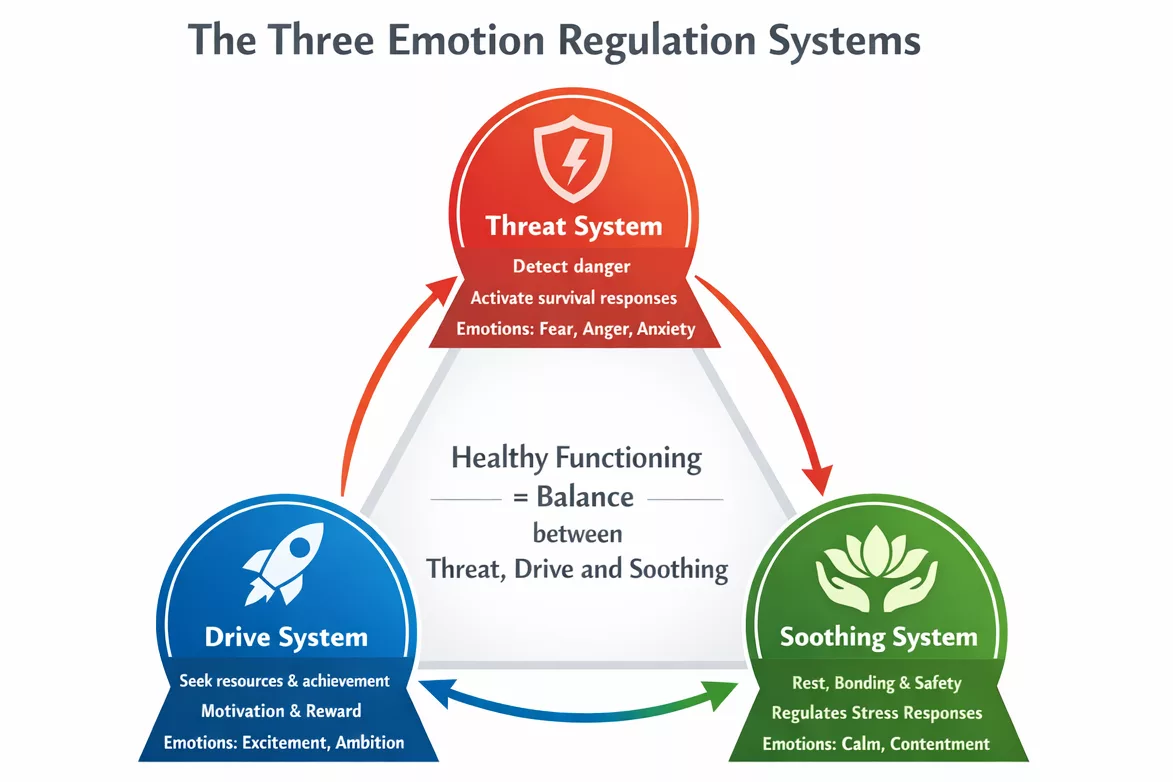
They are not personality traits so they’re not unique to you. They are biological motivational systems that apply to everyone, and in an ideal world, they operate in balance. Modern life however rarely allows that balance.
The idea is that as you live, either on a macro level or task-based level, you move between these evolutionary built-in stress management systems. To get idea of how they evolved to work, let’s consider an example from around 50,000 years ago.
- A man is out hunting and foraging. He is driven, or motivated, to find food so his family doesn’t starve.
- The man catches sight of a tiger which steps out of a clearing into view.
- The man immediately feels the threat posed by the tiger, experiencing anxiety (there is a potential for death) and then stress as his body prepares to take action, which could be to run away, to stand and fight, to play dead or to hide. His nervous system already knows the tiger has seen him so playing dead or hiding won’t work and there aren’t any trees nearby to climb. He has a spear but the tiger is still a way off and he if he runs quickly, there is a better chance to reach safety rather than fight the tiger. The decision to run is made in the blink of an eye by his nervous system. At this point, the man has moved from the Drive system to the Threat system. His heart starts to race as it pumps oxygen and energy to the muscles in anticipation of running. His eyes and hearing become more acute as well. The stress response caused by the threat to his safety has caused a huge change in his biochemistry and how he feels (McEwen, 2007; LeDoux, 2012).
- The man makes it to safety and the crisis is averted. His nervous system calms down and he returns home where he rests and recovers from the toll stress put on his body. He has finally moved to the Soothing system.
The point is that anxiety and stress served him well because it saved his life, and when he had overcome the adversity he relaxed and settled down. The three systems interact exactly in the same way when we face life-threatening dangers as modern humans. Consider the prospect of being attacked late at night because we fear we’re being followed, or after a car accident or after a natural disaster. The same sequence of events happens – we are driven to achieve something in our daily life (Drive), we feel the threat of an imminent danger and stress takes us over, we assess and decide what we will do about it (stress), we take action and then once over we relax and recover (soothe).
Consider your life today and how much of it you feel stress about but how much of it you are actually in life threatening danger. Probably lots of stress but not much life threatening danger. That’s because our emotional system struggles to differentiate between threats that are actually life threatening and those that we simply find threatening maybe because we feel have had an experience that has left us feeling guilty, shameful, angry, defensive and so forth (LeDoux, 2012).
Here is a little more information about each part of the system.
The Drive System – Motivation and Reward

The Drive system evolved to push us toward resources: food, status, safety, mates, shelter. It runs primarily on dopamine and creates motivation, focus and pursuit (Berridge & Robinson, 1998). In evolutionary terms, this system gave us an advantage. If your ancestors were not motivated to seek, hunt, build and compete, they did not survive.
Today, however, Drive has been industrialised. Instead of pursuing food or safety, we pursue promotions, productivity metrics, social validation, financial security, likes, followers and approval. Our modern environment is engineered to stimulate dopamine constantly (our reward system), whether that’s notifications, deadlines, performance targets and comparison culture, they all keep Drive switched on in the pursuit of excellence and being better than anyone else (Alter, 2017). If any of these come under threat, we feel anxiety and stress but what can we do to really eliminate the threat?
The problem is this: the Drive system was built for short bursts of effort followed by rest. It was not designed for perpetual optimisation.
When Drive runs without recovery, it stops feeling like motivation and starts feeling like building pressure, which builds and builds until we explode and go into melt down.
The Threat System – ‘Something is not right’
The Threat system is older and faster. It exists to detect danger and initiate protection. When activated, it releases adrenaline and cortisol, increases heart rate, sharpens attention and prepares you to fight, flee, freeze or submit (McEwen, 2007). Historically, this meant responding to predators or physical attack.
Today though the threats we face are psychological, not physical:
- A critical email
- Financial uncertainty
- Social rejection
- Performance evaluation
- A message left on “read”
Your nervous system does not distinguish particularly well between a tiger and reputational risk. Both can activate survival circuitry (LeDoux, 2012). The Threat system does not care about happiness. It cares about survival.
The Soothing System – ‘Glad that is over’
The Soothing system regulates the other two. It is associated with parasympathetic activation and biochemicals such as oxytocin and endogenous opiates (Gilbert, 2009; Porges, 2011).
This system creates calm, safety, contentment, connection and reward.
It allows recovery. It tells the body: the danger has passed. In evolutionary environments, Soothing followed effort and threat naturally. After hunting came rest. After danger passed came bonding. In modern environments, Soothing is often treated as optional.
The Modern Glitch: When Tigers Become Emails

Your nervous system is ancient. Your environment is not. Thirty thousand years ago, threats were intermittent and obvious. Today they are abstract, continuous and socially amplified. An email can activate the same physiological cascade as physical danger (McEwen, 2007).
Social media comparison can trigger a sense of inadequacy that lights up both Threat and Drive simultaneously:
Threat: “I am not enough.”
Drive: “Work harder. Achieve more. Fix it.”
The result is not balance. It is acceleration.
The Drive – Threat Loop
When modern life triggers Threat, we tend to respond using Drive.
We tell ourselves:
- Work harder.
- Push through.
- Optimise more.
- Achieve your way out of anxiety.
This is culturally rewarded. Hustle culture frames rest as weakness and overwork as virtue. But biologically, this strategy backfires because you cannot out-drive a nervous system that feels unsafe. The harder you push Drive to silence Threat, the more cortisol you generate. The more cortisol, the more exhausted and reactive you feel. This is the core mechanism behind burnout (Maslach & Leiter, 2016).
Burnout is not laziness. It is chronic Threat activation combined with unsustainable Drive output and insufficient Soothing input.
Why You Feel Stuck
When Threat dominates perspective narrows, creativity drops, decision-making becomes rigid, and risk feels catastrophic.
You may stay in situations that harm you because leaving feels more dangerous than enduring but your brain is not malfunctioning (Arnsten, 2009), it is prioritising safety over growth.
The Antidote: Rebalancing Through Soothing

You cannot think your way out of a survival response, you must regulate your way out. The Soothing system must be deliberately engaged in modern life, and that does not mean productivity disguised as self-care. It means genuine physiological down-regulation.
There are three reliable pathways to achieve that balance:
1. Connection
Human nervous systems regulate each other. Safe physical or emotional connection reduces Threat activation and increases oxytocin (Heinrichs et al., 2003). A hug from a loved one, eye contact with a colleague, warmth from a friend, shared presence – these are not sentimental extras. They are biological regulators.
2. Deliberate Rest
Breathing slowly, lengthening the exhale, lying down without stimulation, warm water, stillness. These are not indulgences, they are signals to the nervous system that the tiger has gone and everything is okay (Porges, 2011).
3. Awe and Perspective
Experiences of awe reduce self-focused rumination and activate parasympathetic states. Looking at the sky, the sea, a sunset, or feeling small in something vast recalibrates the nervous system. It does not remove your problems but it does reduce anxiety and panic. When panic reduces, the prefrontal cortex comes back online. You can then re-engage Drive with clarity rather than desperation.
The Real Takeaway

Your emotional systems are not broken. They are misaligned with modern pressures. The goal is not to eliminate Drive or Threat because both are essential. Instead, the goal is rhythm, effort followed by recovery, activation followed by settling, ambition balanced with safety.
The next time you feel the tiger rising in your chest, resist the urge to outrun it through more effort.
Pause.
Regulate.
Then move forward.
Resilience is not built by constant pushing. It is built by repeated cycles of activation and recovery.
That is how the system was designed. More downtime allows more processing, and with that comes greater resilience.
Sources
Alter, A. (2017). Irresistible: The rise of addictive technology and the business of keeping us hooked. Penguin Press.
Arnsten, A. F. T. (2009). Stress signalling pathways that impair prefrontal cortex structure and function. Nature Reviews Neuroscience, 10(6), 410–422. https://doi.org/10.1038/nrn2648
Berridge, K. C., & Robinson, T. E. (1998). What is the role of dopamine in reward: Hedonic impact, reward learning, or incentive salience? Brain Research Reviews, 28(3), 309–369. https://doi.org/10.1016/S0165-0173(98)00019-8
Gilbert, P. (2009). The compassionate mind: A new approach to life’s challenges. New Harbinger Publications.
Heinrichs, M., Baumgartner, T., Kirschbaum, C., & Ehlert, U. (2003). Social support and oxytocin interact to suppress cortisol and subjective responses to psychosocial stress. Biological Psychiatry, 54(12), 1389–1398. https://doi.org/10.1016/S0006-3223(03)00465-7
Keltner, D., & Haidt, J. (2003). Approaching awe, a moral, spiritual, and aesthetic emotion. Cognition and Emotion, 17(2), 297–314. https://doi.org/10.1080/02699930302297
LeDoux, J. (2012). Rethinking the emotional brain. Neuron, 73(4), 653–676. https://doi.org/10.1016/j.neuron.2012.02.004
Maslach, C., & Leiter, M. P. (2016). Understanding the burnout experience: Recent research and its implications for psychiatry. World Psychiatry, 15(2), 103–111. https://doi.org/10.1002/wps.20311
McEwen, B. S. (2007). Physiology and neurobiology of stress and adaptation: Central role of the brain. Physiological Reviews, 87(3), 873–904. https://doi.org/10.1152/physrev.00041.2006
Porges, S. W. (2011). The polyvagal theory: Neurophysiological foundations of emotions, attachment, communication, and self-regulation. W. W. Norton.
Leave a Reply
You must be logged in to post a comment.