
Why Knowing Your Strengths Matters More Than Fixing Your Weaknesses — an article by Carl Argent
Why Knowing Your Strengths Matters More Than Fixing Your Weaknesses
Most self-improvement starts with what is wrong. The research on character strengths, hope and if-then planning points the other way: progress comes faster when you build around what you already do well.
The short answer
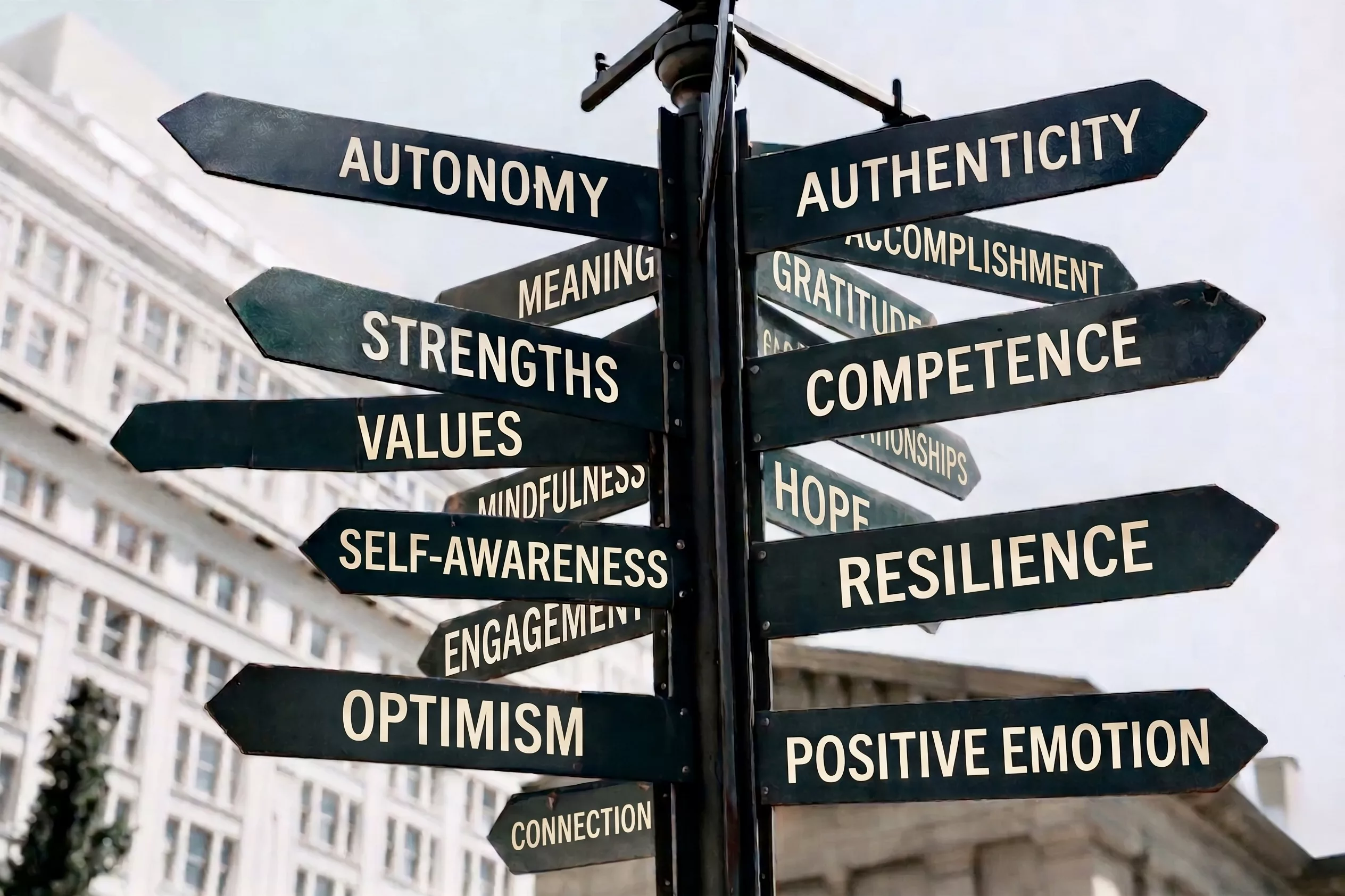
Most attempts at change start with a deficit: I procrastinate, I avoid conflict, I am disorganised, I lack confidence. The plan that follows is usually to work harder at the thing you are worst at. It feels responsible, and it mostly fails, because it asks you to improve using the very capacity that is in short supply. The research on strengths points the other way. People make more progress, and enjoy it more, when they get clear about what they want, identify the strengths they already have, and design the route around those. Weaknesses still matter; you engineer around them rather than lead with them. This article explains why, what the evidence says, and how to try it. If it is easier to name what is wrong with you than what you bring, coaching can help you look again, using examples from your own life.
Why fixing weaknesses feels responsible and rarely works
Deficit thinking is everywhere: school reports, appraisals, the inner voice at 2am. It carries a moral tone, as if attending to what is wrong is the grown-up thing to do and attending to what is right is indulgent. There are three practical problems with it.
The first is energy. Working on a weakness is effortful in a way that working from a strength is not, and effort is a finite daily resource. If your plan for a better week depends on sustained willpower in your weakest area, the plan is fragile by design.
The second is identity. Months of focusing on a shortfall teach you a story about yourself, and the story is not motivating. Many of the people I work with have spent years becoming experts in what they cannot do.
The third is that it confuses the problem with the route. Being disorganised might be the presenting problem, but organisation is rarely the route to solving it for someone who has never been organised. The route is usually something they are already good at: interest, humour, connection with other people, a competitive streak, curiosity, a strong sense of fairness. Those are the tools that get the job done; organisation is what it looks like from outside once the job is done.
What a strength actually is
In everyday speech a strength is anything you are good at. In the research it means something more specific. Peterson and Seligman’s classification describes 24 character strengths, such as curiosity, perseverance, kindness, fairness, humour, hope and self-regulation, that show up across cultures and are recognisable as good in their own right rather than only as means to an end. Everyone has all 24 to some degree; the interesting part is the handful at the top of your profile, sometimes called signature strengths, which feel like you, energise you when you use them, and are easy to spot in the moments you handle well.
My free Strengths Across Life Profile (about fifteen minutes) rates those 24 strengths across four areas of your life, your inner life, relationships, work and challenges, and emails you a report with your top five. It is a reflective coaching tool rather than a psychometric test, and it does not tell you what to do. What it gives you is a vocabulary for what you are already doing when things go well, which turns out to be most of what coaching needs.
The evidence: strengths, goals and wellbeing
The research here is more modest than the self-help shelf suggests, and more useful. Seligman and colleagues tested a set of wellbeing exercises against a placebo in a large online study. Using a signature strength in a new way each day for a week produced increases in happiness and reductions in depressive symptoms that were still present six months later; simply writing down your strengths, with no instruction to use them, did not.
Linley and colleagues looked specifically at goals. People who used their signature strengths in pursuit of a goal made more progress towards it over three months, and the progress was linked to greater satisfaction of basic psychological needs and better wellbeing. That is the finding coaching leans on: strengths are not decoration, they are the mechanism by which people get things done that matter to them.
Two cautions belong here. Most of these studies rely on self-report and effect sizes are moderate rather than dramatic. And the benefit comes from use, not from knowing. A profile on your phone changes nothing; a plan that puts curiosity to work on the report you keep avoiding might.
Where strengths go wrong
The strengths conversation has an honest critic, and it is right. A strength overplayed becomes a problem: perseverance turns into not knowing when to stop, kindness into never saying no, humour into deflecting anything serious. A strength misapplied to the wrong situation does not help either. Strengths-based coaching that ignores this becomes cheerleading, and people with real difficulties, ADHD for example, can hear it as being told the hard parts are not real.
The version that works has two halves. Use the strengths deliberately, and engineer around the weaknesses without pretending they are not there. If working memory is unreliable, the answer is not to try harder to remember; it is a system that does not depend on remembering. The strength is what gets you to build and keep the system.
Hope: a goal, more than one route, and belief
The single most useful idea I know for turning a strengths profile into progress comes from Snyder’s hope theory. In this research hope is not optimism or a feeling; it is a way of thinking with three parts: a clear goal, pathways (more than one route to it), and agency (the belief that you can walk those routes). People high in this kind of hope do better at work, in study and in health, and the reason is mechanical rather than mystical. When one route is blocked, they already have another, so a setback is a detour rather than the end.
This is where consumers of coaching and the research finally agree. What people say they want from a coach is clarity, a plan and confidence. That is a goal, pathways and agency, in plain words. Strengths supply the pathways: each signature strength is a different route to the same goal.
If-then plans: deciding in advance
Good intentions are cheap. Gollwitzer and Sheeran’s meta-analysis of 94 studies found that plans in the form “if situation X arises, then I will do Y” had a medium-to-large effect on whether people actually did the thing, across health, study and work. The reason is that the decision has already been made, so the moment does not have to be won by willpower.
The version I use in coaching, which I call the Next Step plan and which borrows from Oettingen’s work, takes about ten minutes: name what you want, picture the best thing about getting it, name the obstacle honestly (usually an inner one), then write the if-then. “If I open my inbox before the report, then I close it and write the first sentence.” Every session should end with one, and the next session starts by asking what happened.
Getting back on track
Any real plan will be missed. The research on self-compassion, largely from Neff’s work, suggests that what predicts whether people keep going is not how hard they are on themselves after a lapse but how quickly they recover from it. Treating a missed step as information (“that route was blocked; what is the next one?”) keeps the hope machinery running. Treating it as evidence against yourself switches it off. This is a skill, not a temperament, and it can be practised.
Try it this week
Complete the Strengths Across Life Profile and look only at your top five. Pick one situation from the last month that you handled well and notice which of those strengths were in play. Then choose the thing you keep not doing and ask, of each of the five, “how would this strength approach it?” You will usually get two or three genuinely different routes. Choose one, write a Next Step plan for it, and give it a week. When you miss a day, and you will, treat it as a note about the route and not a verdict on you.
Quick answers
Is strengths-based coaching just positive thinking?
No. It does not ask you to feel differently about your situation; it asks you to be specific about what you are good at and design the route to your goal around it. Difficulties are named and worked around, not reframed away.
Should I ignore my weaknesses altogether?
No. The evidence supports leading with strengths and engineering around weaknesses, usually with systems or support that do not depend on the weak area. Ignoring a weakness that is blocking you is a different, and worse, strategy.
Is the Strengths Across Life Profile a validated test?
No, and it does not claim to be. It is a reflective coaching tool built on the 24 character strengths in Peterson and Seligman’s classification, scored across four areas of your life rather than in the abstract. If you want a validated instrument, the VIA survey is free and linked in the sources. In coaching the profile earns its keep as a conversation starter and a map of routes, not as a score.
How is this used in coaching with you?
If we agree to use a strengths profile, we discuss how it could help the work. It is not a requirement for the free introductory conversation. In coaching sessions, we can explore what better would look like, agree a next step and review what happens when you try it. A programme gives us more time to develop and revisit that work.
If you want to take this further
If you can list your weaknesses more readily than your strengths, we have somewhere to begin. I can help you notice the qualities you already use and consider how they might support a change that matters to you. You do not need to complete a profile or arrive with a clear goal before our first conversation. You can book a free introductory conversation, with no obligation to book sessions, or read more about coaching with me.
Sources and further reading
Carl Argent. Strengths Across Life Profile: a free reflective profile of the 24 character strengths across inner life, relationships, work and challenges.
VIA Institute on Character. The VIA character strengths survey (a validated alternative).
Peterson, C., & Seligman, M. E. P. (2004). Character Strengths and Virtues: A Handbook and Classification. Oxford University Press / American Psychological Association.
Seligman, M. E. P., Steen, T. A., Park, N., & Peterson, C. (2005). Positive psychology progress: empirical validation of interventions. American Psychologist, 60(5), 410–421.
Linley, P. A., Nielsen, K. M., Gillett, R., & Biswas-Diener, R. (2010). Using signature strengths in pursuit of goals: effects on goal progress, need satisfaction, and well-being. International Coaching Psychology Review, 5(1), 6–15.
Snyder, C. R. (2002). Hope theory: rainbows in the mind. Psychological Inquiry, 13(4), 249–275.
Gollwitzer, P. M., & Sheeran, P. (2006). Implementation intentions and goal achievement: a meta-analysis of effects and processes. Advances in Experimental Social Psychology, 38, 69–119.
Oettingen, G. (2014). Rethinking Positive Thinking: Inside the New Science of Motivation. Current.
Neff, K. D. (2003). Self-compassion: an alternative conceptualization of a healthy attitude toward oneself. Self and Identity, 2(2), 85–101.
More coaching reading
What Actually Changes in Six Sessions of ADHD Coaching
ADHD Hyperfocus vs Flow: Interest, Choice and Getting Things Done
Coaching with Carl Argent. In Southend-on-Sea and online across the UK.
Person-centred, practical and measured against where you started, beginning with your strengths profile and a clear goal.
About coaching